
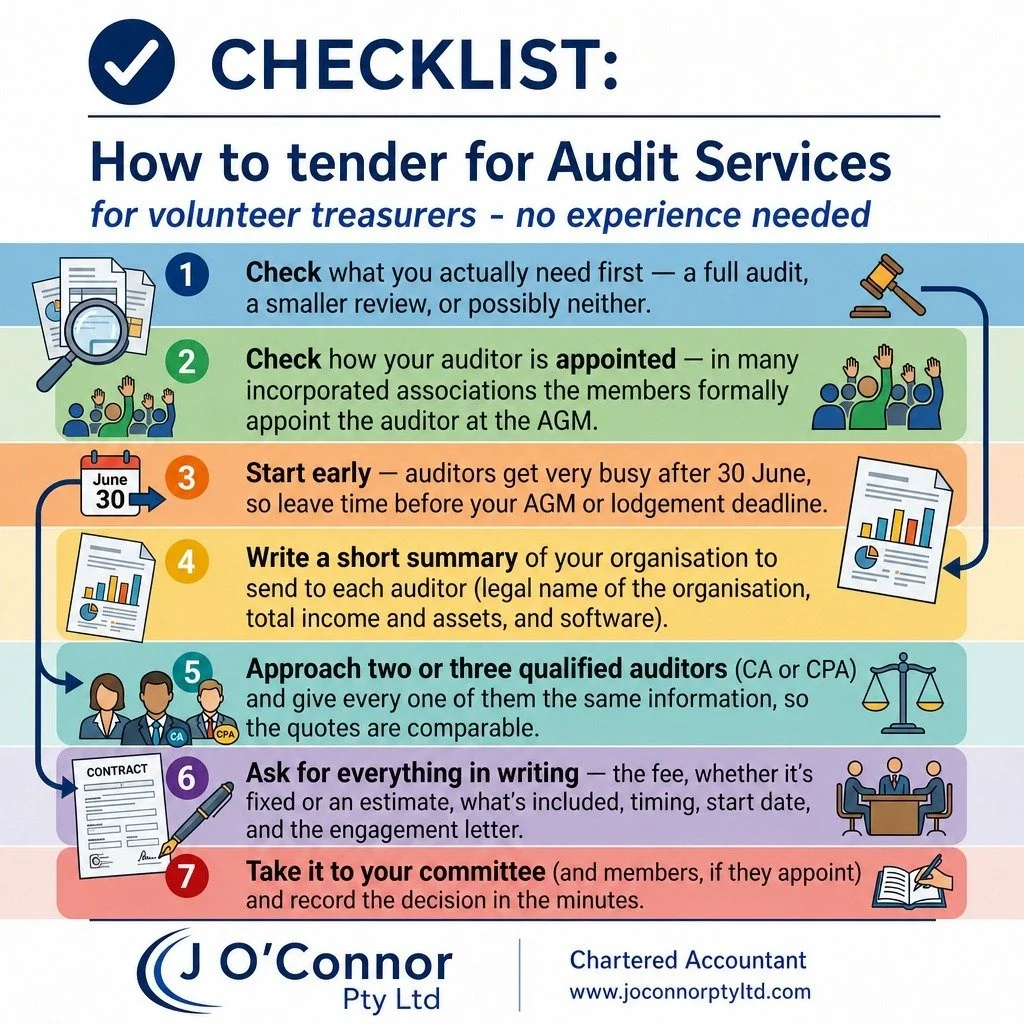
To tender for audit services, ask two or three qualified auditors for written quotes based on the same information about your organisation, then compare them on price, experience, independence and terms before your committee appoints one.
A New Treasurer's Guide
A tender for audit services simply means asking two or three qualified auditors to quote for the work, so your committee can compare price, experience and service before appointing one. You do not need any accounting background to run one well. You only need to ask a few clear questions and give each auditor the same information.
Many new treasurers feel nervous about this task. You have just taken on the role, someone has mentioned the organisation needs its books audited, and now you are expected to find an auditor. That is a very common situation, and it is easier than it looks.
First, check whether you actually need an audit
Before you contact anyone, find out what your organisation is actually required to do. Not every group needs a full audit. Some only need a review, which is a lighter and cheaper process.
Your requirement usually comes from three places: your constitution or rules, the law that governs your organisation, and any funding agreements. In Queensland, for example, incorporated associations follow the Associations Incorporation Act 1981 (Qld). Registered charities also follow the rules of the Australian Charities and Not-for-profits Commission (ACNC).
If you are unsure which applies to you, that is a reasonable first question to put to an auditor. A good one will tell you honestly if a review would meet your needs instead of a more expensive audit.
What information should you give each auditor?
The most common mistake is asking for a quote without giving enough detail. If each auditor receives different information, you cannot compare their prices fairly.
To give a useful quote, an auditor usually needs to know: the legal name of your organisation, a copy of your latest audited financial statements, a copy of your latest management accounts, what accounting software you use, and the deadline you are working towards.
Send the same short summary to everyone you approach. This one step makes the whole process fairer and faster.
What to ask for in a quote
Ask each auditor to confirm, in writing, the fee for the work, what the fee includes, how long the audit will take, when they could start, and to provide their engagement letter. Ask whether the fee is fixed or an estimate, because an estimate can grow if your records are untidy.
It is also fair to ask what they will need from you. Knowing this early helps you prepare and avoids delays later.
What to compare, beyond price
Price matters, but it is not the only thing. The cheapest quote is not always the best value.
Check that the auditor is properly qualified and, where required, registered to do the work. Ask whether they have experience with organisations like yours, because a charity, a sporting club and a P&C association each have their own quirks.
Independence is also important. The person who audits your accounts should not be the same person who prepared them or keeps your books. An auditor's job is to give an independent opinion, and that only works if they are genuinely separate from the day-to-day finances.
Common misunderstandings
One of the biggest misconceptions is that you must simply keep using the same auditor forever. You are allowed to seek fresh quotes, and doing so occasionally is good practice.
Another is that a low fee means the audit will be easier. In practice, the fee reflects the work involved. Very tidy records usually cost less to audit than messy ones, whatever the quoted price.
A third is that changing auditors is awkward or rude. It is a normal business decision. A professional auditor will not take offence, and your new auditor can request the previous year's information in the usual way

Running a tender for audit services is not really an accounting task. It is a matter of asking clear questions, treating each auditor the same way, and comparing more than just the price.
You do not need experience to do this well in your first year. You only need to be organised and fair, and to remember that a good auditor will happily explain anything you do not understand.
If your organisation is preparing to appoint an auditor and would like to talk through your circumstances, we are happy to help.