What Is a Depreciation Policy? A New Treasurer's Guide

A depreciation policy is a short written document, adopted by your management committee, that sets out which purchases your not-for-profit records as assets, how quickly their cost is spread over the years you use them, and who made those decisions.
You're the New Treasurer — and Someone Mentions Depreciation
Here's the short answer up front: a depreciation policy is a written document, adopted by your committee, that answers three questions — which purchases count as assets, how quickly their cost is spread across the years you use them, and who decided that. If your organisation owns anything that lasts more than a year — a mower, a laptop, a building — you need one.
Many treasurers of not-for-profit organisations are volunteers. You put your hand up at the AGM, someone passed you a folder (or a login), and now you're the treasurer. Nobody mentioned depreciation at the time.
Then the auditor asks: "Can I see your depreciation policy?" And you think — our what?
You're not alone. This is one of the most common gaps we see in small organisations, and it's nobody's fault. The good news is that a depreciation policy is short, simple, and something your committee can put in place at its very next meeting.
Why Depreciation Catches New Treasurers Out
Depreciation is different from most of what a treasurer does, for a few reasons:
It isn't a payment. Every other number in your accounts matches money moving through the bank. Depreciation doesn't — it's a bookkeeping entry that spreads the cost of an asset over the years you use it. That makes it feel invisible until someone asks about it.
The rules are choices, not facts. How long will the photocopier last? Should a $400 kettle be an asset or an expense? There's no single right answer — someone has to decide, and that decision should be written down.
The decisions outlive the people. Committees change every year. Without a written policy, each new treasurer inherits numbers in the software with no idea where they came from — or quietly starts using different ones.
Accounting software hides it. The software calculates depreciation automatically using whatever rates were typed in years ago. If nobody wrote those rates down and had them approved, nobody can say whether they're still right.
What Is a Depreciation Policy?
A depreciation policy is your committee's written answer to four practical decisions. The Australian accounting standard behind it is AASB 116 Property, Plant and Equipment, but you don't need to read the standard — you need to make four choices in plain English:
Which purchases become assets? This is called the capitalisation threshold. Anything costing less than your chosen figure is simply an expense in the year you buy it; anything at or above it goes on the asset register and is depreciated. The standard doesn't set a magic number — your committee picks one that suits your size. Many small not-for-profits choose somewhere between $500 and $5,000.
What does an asset cost? The purchase price plus whatever it took to get it in place and working — delivery, installation, site preparation. Donated assets are recorded at their fair value on the day you receive them.
How long will each type of asset last? This is the useful life — a reasonable estimate, not a prophecy. A five-year life means the cost is spread over five years. You review the estimates each year and adjust them if something is wearing out faster (or lasting longer) than expected.
What method do you use? Most small organisations use straight-line depreciation: the same amount each year, starting when the asset is ready for use. The rate is just 100 divided by the useful life — a five-year life means 20% a year. Freehold land is never depreciated.
Write those four decisions down, have the committee adopt them by resolution, record it in the minutes — and you have a depreciation policy.
Common Weaknesses We See in Small Organisations
When we audit or review small not-for-profits, the same gaps come up again and again:
No policy at all. The rates in the software were set by a treasurer three handovers ago, and nobody can explain them.
No asset register. The financial statements show a total for "plant and equipment," but there's no list of what the organisation actually owns, where it is, or who looks after it.
Everything is expensed — or everything is capitalised. Without a threshold, one treasurer writes off a $2,000 mower as an expense while the next records a $60 toaster as an asset. Neither is wrong on purpose; they were just never told the rule.
Assets that no longer exist. The register (or the software) still carries equipment that was scrapped, sold or lost years ago, because nobody has authority to remove it.
Rates that never change. Useful lives are estimates, and estimates should be reviewed each year. In many organisations they haven't been looked at since they were first typed in.
None of these mean anyone has done anything dishonest. They mean the organisation has been relying on individual memory instead of a written policy — and memory leaves with every outgoing treasurer.
Simple Steps Every Committee Should Take
Adopt a written policy. Cover the four decisions above: threshold, cost, useful lives and method. Have the committee pass a resolution and record it in the minutes.
Keep an asset register. A simple list: what the asset is, when it was bought, what it cost, its useful life and rate, depreciation to date, and where it is. Reconcile the totals to the financial statements each year.
Set the threshold once, apply it always. The figure matters less than the consistency. Pick a number, write it down, and apply it to every purchase.
Review useful lives annually. Before the financial statements are finalised, the treasurer checks whether the estimates still look reasonable and takes any proposed change to the committee — decided and minuted before it's applied.
Require a committee resolution for disposals. No asset is sold, scrapped, traded in or given away on one person's say-so. The resolution protects the volunteer doing the disposing as much as the organisation.
Keep the policy separate from the audit. Your auditor or reviewer — whether they're a CA, CPA or IPA member — checks your statements against your policy, but must never write the policy for you. If they wrote it, they'd be auditing their own work, and their independence would be gone. The policy belongs to your committee.
Notice a theme: every one of these steps protects the honest volunteer. When the rates and rules are adopted by the committee and written down, no individual treasurer is ever left guessing, and no one's judgement is under suspicion by default.
Why This Matters for Governance
For ACNC-registered charities, Governance Standard 5 requires the people who govern the charity to make sure its financial affairs are managed responsibly. A written depreciation policy, an asset register that matches the accounts, and minuted decisions are exactly the kind of evidence that responsibility is being taken seriously.
For Queensland incorporated associations, the Associations Incorporation Act 1981 requires the association to keep financial records that correctly record and explain its transactions and financial position. If your asset values rest on rates nobody can explain, that's hard to demonstrate.
And under AASB 116, the responsibility for these decisions sits with those charged with governance — your committee or board as a whole, not the treasurer alone, and certainly not the auditor. The treasurer drafts and applies the policy; the committee owns it.
Sample Depreciation and Asset Recognition Policy
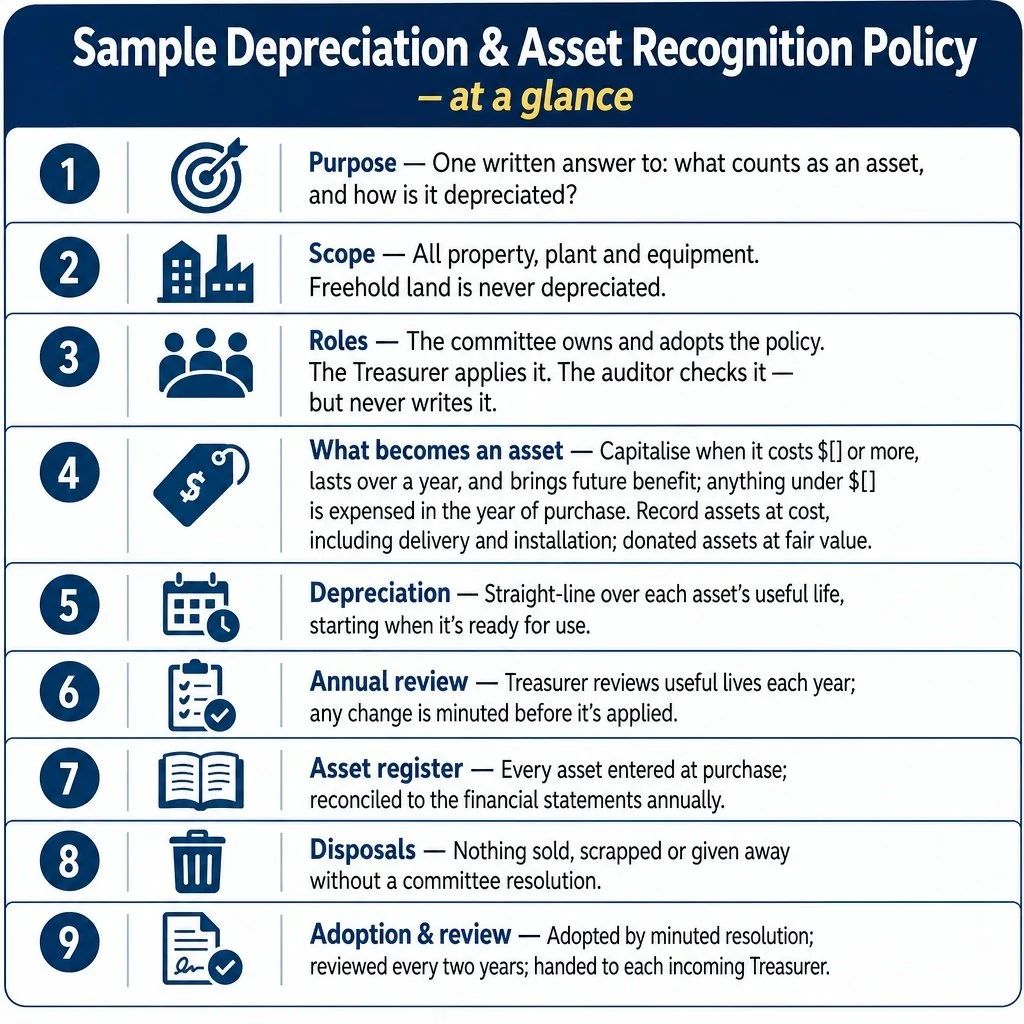

A depreciation policy isn't red tape. It's one or two pages that turn a stream of individual guesses into a set of committee decisions — decisions that survive every handover and answer the auditor's question before it's asked.
If you're a new treasurer and your organisation doesn't have one, that's not a crisis. It's an agenda item. Draft it, take it to your next committee meeting, and have it adopted and minuted.
And if you'd like a hand — with the policy, the asset register, or your audit or review more broadly — we're always happy to talk to treasurers, new or old.