Your First Year-End as Treasurer?

Becoming the treasurer of a community organisation is rewarding, but as your first financial year-end approaches, it’s completely normal to wonder what records you’ll need and what happens during an audit or financial review.
Your First Year-End as Treasurer? Here’s What to Expect
When I accepted the role of treasurer, I thought my biggest challenge would be paying invoices and reconciling the bank account.
Then someone mentioned…
“Don’t forget the audit.”
Or perhaps they said…
“We have our annual review coming up.”
Suddenly I found myself asking questions I never expected.
What happens during an audit?
What’s the difference between an audit and a review?
What records do I need?
Have I done everything correctly?
If this sounds familiar, you’re certainly not alone.
Every year, hundreds of volunteer treasurers across Queensland take on the role for the first time. Most are parents, retirees, committee members or volunteers who simply wanted to help their organisation—not accounting professionals.
The good news is that year-end doesn’t have to be stressful.
Step 1 – Understand Whether You Need an Audit or a Review
The first thing to understand is that not every organisation requires the same level of assurance.
Depending on your organisation’s legislation, constitution, funding agreements or regulator, you may require:
a financial review
an audit
or, in some cases, a verification of the financial statements.
For many Queensland incorporated associations, the reporting requirements depend on the size of the association and whether other legislation or funding agreements require an audit.
Regardless of which engagement applies, the objective is the same—to provide confidence to members, donors, grant providers and other stakeholders that the financial statements are reliable.
Step 2 – Make Sure Your Accounts Are Complete
Long before your accountant or reviewer begins their work, your bookkeeping should be finalised.
This usually includes:
Reconciling every bank account to year-end.
Reconciling term deposits and investment accounts.
Making sure all income has been recorded.
Recording all supplier invoices and expenses.
Ensuring payroll, superannuation and GST have been processed correctly.
Reviewing outstanding debtors and creditors.
The cleaner your accounting records are before the engagement starts, the smoother the entire process becomes.
Step 3 – Gather Your Supporting Documents
One of the biggest surprises for new treasurers is that the financial statements are only part of the process.
Your auditor or reviewer will normally request supporting documentation such as:
Bank statements for every account.
Term deposit confirmations.
Copies of invoices for significant expenditure.
Minutes of committee meetings.
Payroll reports.
BAS or IAS lodgements (where applicable).
Asset registers.
Grant agreements and acquittals.
Loan agreements, if any.
Details of any significant events after year-end.
Think of these documents as the evidence supporting the numbers in your financial statements.
Step 4 – Expect Questions
Many first-time treasurers worry when they receive a list of questions.
In reality, questions are a normal part of both an audit and a review.
Your auditor or reviewer may ask things like:
Can you explain this transaction?
Why did expenses increase this year?
Can you provide the missing invoice?
Was this purchase approved by the committee?
Has the committee approved the financial statements?
These questions are not an indication that something is wrong—they simply help us understand the organisation and obtain sufficient appropriate evidence before issuing our report. Reviews and audits are designed to provide assurance by gathering evidence appropriate to the level of assurance being provided.
Step 5 – Don’t Leave Everything Until the Last Week
The most successful year-ends usually begin several weeks before the financial year finishes.
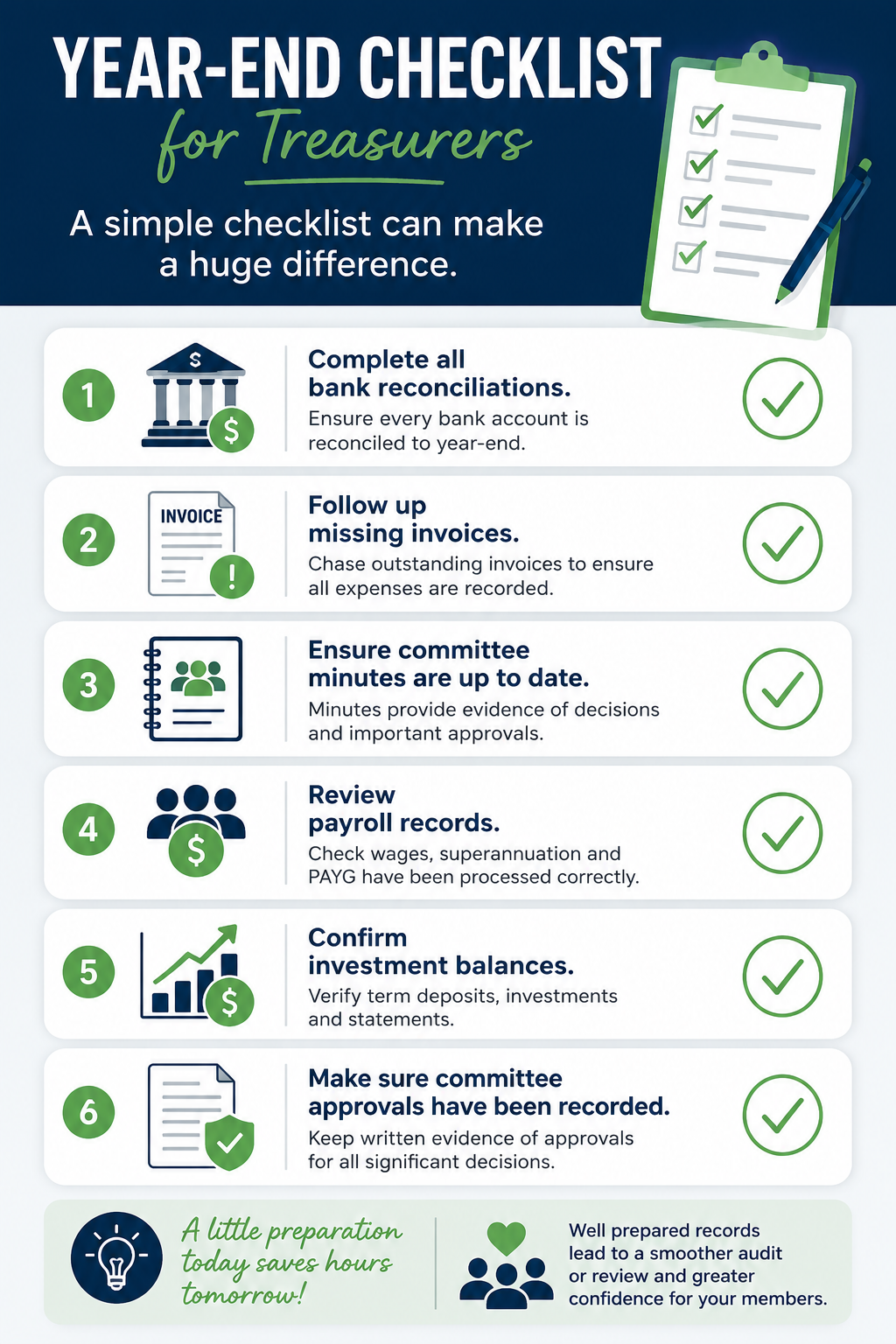
A simple checklist can make a huge difference.
✔ Complete all bank reconciliations.
✔ Follow up missing invoices.
✔ Ensure committee minutes are up to date.
✔ Review payroll records.
✔ Confirm investment balances.
✔ Make sure committee approvals have been recorded.
Doing a little preparation throughout the year often saves many hours after year-end.
Remember—You’re Probably a Volunteer
One thing I’ve learnt after working with hundreds of community organisations is this:
Most treasurers aren’t accountants.
They’re volunteers.
They’re juggling families, careers, committee meetings and fundraising events, all while trying to keep the books in order.
No one expects a volunteer treasurer to know every accounting standard or piece of legislation.
That’s why your auditor or reviewer should guide you through the process, explain what is required in plain English, and help make the year-end as straightforward as possible.

We’re Here to Help
At J O’Connor Pty Ltd, we understand what it’s like to be a first-time treasurer.
Whether you’re involved with a sporting club, church, incorporated association, charity, kindergarten, P&C or community organisation, our goal is to make the year-end process simple and stress-free.
We provide:
Fixed-price engagements with no surprise invoices.
Clear checklists explaining exactly what records are required.
Secure electronic document upload through Dropbox Request.
Electronic signing via Dropbox Sign.
Friendly guidance throughout the engagement.
A typical turnaround of approximately two weeks once complete records are received.
Your first year-end doesn’t have to be overwhelming.
With the right preparation—and the right support—it can simply become another successful milestone for your organisation.