
If a not-for-profit has gone several years without an audit or review, the simplest way forward is usually to start fresh from the current year: get this year's books right, confirm the opening balances, and have the current year audited or reviewed, with a note in the report that earlier years were not audited or reviewed. A new treasurer looks after their own year, and the past doesn't need re-doing. It is a manageable job, far more common than committees think, and done this way it is a win-win for all parties.
Introduction
Every year we take calls that start the same way. A new treasurer has picked up the books, or a new president has asked a simple question at a meeting, and someone has quietly realised that the last audited statements are dated three, four, sometimes seven years ago.
The first feeling is often surprise. The second is often worry about how to raise it without upsetting the people who were there before.
It can be raised kindly, and it is worth raising. Falling behind is not a sign that anyone did anything wrong. Most of the people involved were volunteers doing their best with the time they had. It is usually a sign that a volunteer left, nobody picked up the job, and each year the gap got a little harder to talk about. Our job is to help you close it calmly. Here's how.
How did this happen?
In our experience there are only a handful of causes, and none of them are dramatic:
The treasurer who "did everything" moved away, got sick or simply stepped down, and the handover never happened.
The organisation grew past a reporting threshold without anyone noticing that the rules had changed.
The accounting software (Xero, MYOB or a spreadsheet) fell behind, the bank reconciliations stopped, and nobody had the time to catch them up.
The previous auditor retired or stopped answering emails, and appointing a replacement slipped through the cracks.
COVID. Several organisations we now work with simply stopped meeting in 2020 and never restarted the paperwork.
Work out which of these happened to you, because it tells you where to start. If the books stopped, you need a bookkeeper first. If only the audit stopped, you may be closer to fixed than you think.
A lesson from Toyota
Toyota is famous for quality, but it got there by treating problems as normal and fixable. In the 1890s its founder, Sakichi Toyoda, built looms that stopped by themselves when a thread broke, so one fault didn't spoil a whole roll of cloth. Toyota later turned that idea into the andon cord: anyone on the assembly line who spots a problem pulls it, and the line stops until the problem is fixed. Pulling it is welcomed, because it helps everyone.
When Toyota faced a wave of recalls in 2009 and 2010, its president, Akio Toyoda, didn't look back at the people before him. He stood before the US Congress, acknowledged the company had grown faster than its quality checks, and set out what would change.
A new treasurer who finds missing audits is pulling the andon cord. The job is to pause, improve the process and move forward together.
What are we actually required to do?
This depends on what kind of organisation you are.
Queensland incorporated associations. Under the Associations Incorporation Act 1981 (Qld), the management committee must keep proper financial records and prepare financial statements each year. It must have them audited or verified to the level the Act requires and present them at an annual general meeting held within six months of year end. Then it must lodge an annual return with the Office of Fair Trading within one month of the AGM. What the audit or verification looks like depends on your size — small, medium or large. Our guide to the three reporting levels explains the current thresholds.
ACNC-registered charities. Charities must lodge an Annual Information Statement with the ACNC within six months of the end of each reporting period. Medium charities (revenue of $500,000 or more) must also lodge a financial report that has been reviewed or audited, and large charities ($3 million or more) must have theirs audited. Keeping these up to date keeps your charity registration, and the tax concessions that come with it, secure.
Associations that are also charities. Many Queensland charities are also incorporated associations. The good news is that you only report once. If your association is registered with the ACNC, you lodge your Annual Information Statement with the ACNC and include your Queensland IA number. You do not lodge a separate annual return with the Office of Fair Trading. You still hold your AGM, present the statements to members, and tell the Office of Fair Trading about any change of office bearers or address. If you report to the ACNC as part of a group, check with the Office of Fair Trading, because you may still need to lodge with them.
Grant funders, council leases and your own rules. Check your funding agreements and your constitution. Many grants require audited statements regardless of size. If you lease a hall, clubhouse or grounds from your local council, check the lease too: many council leases require at least a review before they will renew it. Some constitutions still say "audited" even when the Act would allow a review.
👉 If you are not sure which applies to you, ask us. Working that out takes five minutes and costs nothing.
The seven steps to catching up
1. Tell the committee, and minute it. The management committee looks after the financial records, so the committee leads the way forward together. A short minute — "the committee notes that financial statements for the years ended 30 June 2023, 2024 and 2025 have not been audited and resolves to have the current year audited or reviewed" — turns a worry into a plan. Frame it as a plan for the year ahead, not a review of the past. Some of the people around that table may have served in those years, and they are often the ones who know where the records are.
2. Gather what exists. This year's bank statements for every account, the last audited statements (if you can find them), any grant agreements or council lease, payroll records if you have staff, and whatever accounting file you have — even if it isn't up to date. Don't tidy anything yet. Just collect it.
3. Get this year's books reconciled. Start with your own year. Every bank account must be reconciled to the actual bank statement, and the opening balances — what the organisation held on the first day of your year — need to be confirmed against the bank. You don't need to re-do every prior year to do that, and you shouldn't feel you have to. You are looking after your own year, not re-checking the work of the people before you. That's a win-win: you get a clean start, and their contribution is respected. If the books need more help than you can give, a bookkeeper can step in — we work alongside specialist not-for-profit bookkeepers and can introduce you to one. See our unaudited financial statements page for the common issues they usually find first.
4. Prepare this year's financial statements. Their opening balances must agree with the last figures you can rely on — the last audited statements, or the reconciled bank balances at the start of your year. If statements for the missing years were never presented to members, the committee as a whole decides how to deal with that. It isn't a job the new treasurer has to take on alone.
5. Decide which years need an audit or review. You don't have to audit every missing year. If your size means a review is enough, the missing years may only need a review. Otherwise, you can go forward from the current year: your auditor audits or reviews this year and adds an "Other Matter" paragraph to the report, saying the earlier years were not audited or reviewed. That paragraph is a neutral note. It simply tells readers where the checked figures start. That's why the opening balances in step 3 matter: they are where your auditor's work begins. Whichever way you go, ask for the engagement letter up front, before any work starts — our post on engagement letters vs audit reports explains why. If you are choosing an auditor for the first time, our guide to tendering for audit services walks a new treasurer through it. Whoever you appoint must be independent: not the bookkeeper who reconciled the accounts, and not a committee member. A CA, CPA or IPA member is a good place to start.
6. Hold the meeting and lodge. Present this year's audited or reviewed statements at a general meeting (your AGM, or a special general meeting if you don't want to wait) and minute their adoption. Then lodge with the right regulator, together with anything the committee has agreed to bring up to date: annual returns with the Office of Fair Trading, or — if you are a registered charity — Annual Information Statements with the ACNC, quoting your IA number. Lodging shows members and regulators that the organisation is back on track.
7. Make it easier next time. Appoint the auditor for the current year now, put "financial statements adopted / auditor appointed" on the AGM agenda as a standing item, and write a one-page treasurer handover so the next treasurer starts with a clear picture. Our post on your first year-end as treasurer is a good handover starting point.
How long does it take, and what does it cost?
The honest answer is that the bookkeeping is the long part. Reconciling a busy club's year can take a bookkeeper a few weeks, especially if receipts are missing. Once the books are up to date, we can generally complete a review or audit within two weeks per engagement, and for catch-up years done together it is often faster than that.
On cost, ask for a fixed fee in one quote, covering every year that needs checking, so the committee can approve a single known figure. We price catch-up work this way for exactly that reason — a known figure makes the decision easy for everyone.
Common traps to sidestep
❌ Assuming every missing year must be audited. It usually doesn't. Talk to your auditor first: a review of the missing years, or starting fresh from this year with an Other Matter paragraph, is often enough — and far cheaper.
❌ Asking the bookkeeper to also do the audit. Whoever prepares or fixes the records cannot independently check them. It's simply good practice that supports the bookkeeper and the committee alike.
❌ Holding the AGM without the statements. An AGM that "notes" the accounts aren't ready doesn't complete the job. Hold a special general meeting once they are.
❌ Staying quiet with the regulator. Regulators are there to help. Most are glad to hear from organisations that are catching up. A short email saying "we have identified a gap and have a plan" shows good governance.
❌ Assuming years behind means bad news. Out-of-date books tell you nothing either way. Once they're reconciled, the position is often better than expected. If it isn't, our post on going concern explains the next questions to ask.
❌ Looking back instead of forward. Going back through old years rarely changes the numbers, and the new treasurer's goodwill is better spent on the year ahead. The auditor's Other Matter paragraph notes the earlier years neutrally — that's all that's needed.
Practical tip
Before you ring anyone, write three things on a single page: the last year that was audited, every bank account the organisation holds (including term deposits and any card accounts), and the name of the accounting software or spreadsheet you use. Almost every question an auditor or bookkeeper will ask you in the first conversation can be answered from that page. It is also the same information we ask for when we prepare a fixed-fee quote.
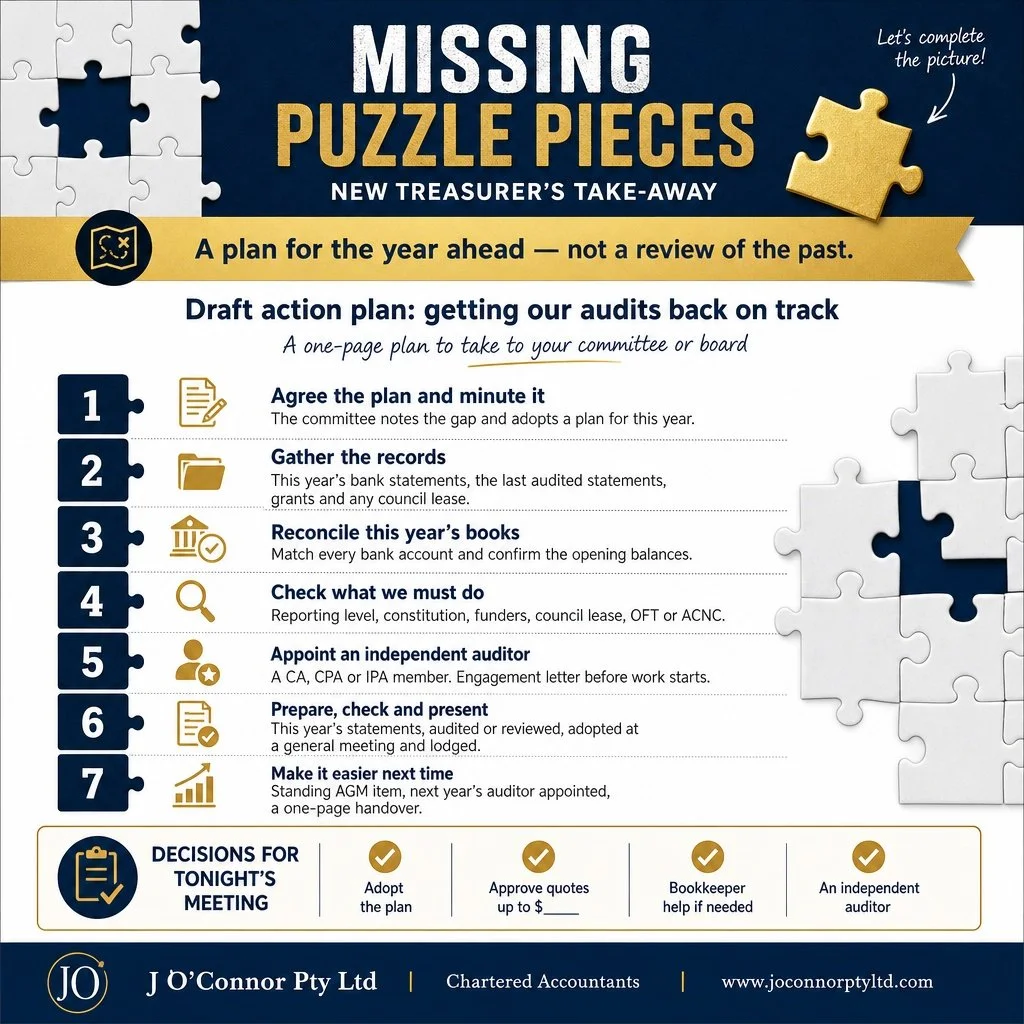
Your take-away: a draft action plan
We've put the steps above into a one-page draft action plan you can take to your committee or board. It sets out what needs doing, who does it and by when, the decisions needed at the meeting, and a suggested minute. It is written as a plan for the year ahead, not a review of the past, so you can present it without putting anyone on the spot. Fill in the brackets, adapt it to suit, and table it at your next meeting.
FAQs
Can we just skip the missing years and start fresh from this year? For the audit or review, often yes. Your auditor can audit or review the current year and add an "Other Matter" paragraph to the report saying earlier years were not audited or reviewed. You still need confirmed opening balances, and the committee should decide together how to deal with any overdue returns. Check your grant agreements and any council lease too — some funders want audited figures for every year they funded, and many councils want at least a review before they renew a lease.
What if something in the old records doesn't make sense? Mention it privately to the president or your auditor, rather than at a general meeting. Most questions turn out to be missing paperwork, and a quiet conversation keeps everyone on the same page. If anything needs follow-up, your auditor can help the committee with it.
We're a registered charity. Do we lodge with both the ACNC and the Office of Fair Trading? Usually not. A Queensland incorporated association that is registered with the ACNC reports once, through its Annual Information Statement, with its IA number included. You still need to tell the Office of Fair Trading about changes to office bearers or your address.
Our old auditor has the previous files. Do we need them? They help, but they are not essential. The last set of audited statements gives the new auditor a verified starting point. If you can't get them, the bank statements at the last audited year end will do the job.
We changed from a spreadsheet to Xero halfway through. Is that a problem? Not at all — it's common. Tell the bookkeeper the date of the change so the opening balances can be entered properly, and keep the old spreadsheet for the auditor.
We've missed some ACNC statements. Is it too late? Not at all. The ACNC writes to charities before taking any action, and it welcomes charities that get in touch. Lodge the overdue statements as soon as you can and let the ACNC know you're catching up.

Three missing years can feel like a big hill to climb. They are really one year's job done properly, then one audit or review to get you back on track. Done this way, it's a win-win for all parties: the new treasurer gets a clean start, the previous committee's work is respected, and members get accounts they can trust. Every organisation we have helped through this said the same thing afterwards: the hardest part was making the first phone call.
If your organisation is ready to catch up, we'd love to help you take the first step. Send us the legal name of your organisation, the software you use and the last year that was audited, and we'll give you a fixed-fee quote for bringing everything up to date. Contact us.
This article is general information, not financial or legal advice. Seek advice for your organisation's specific circumstances.